National Space Development Agency of Japan
5 Centimeters per SecondThe National Space Development Agency of Japan is presented less through an account of its internal structure than through the things its space program leaves in view: dated launch photographs, a carefully escorted rocket transport, and the launch itself, seen from Tanegashima. These traces make the agency part of the island’s everyday environment while linking the wonder of a teenage spectacle to the communications technology that later becomes part of Takaki Tohno’s working life.
Institutional presence on the island
The story locates the agency in a specific landscape and in ordinary encounters with its evidence. In a winding hall on Tanegashima, Kanae Sumida passes a row of framed photographs of rockets launching through clouds of smoke. Their captions preserve the exact dates and times of two events: H-II ROCKET F4 LAUNCH on August 17, 1996, at 10:53, and H-II ROCKET F6 LAUNCH on November 28, 1997, at 6:27. The photographs are records of distant launches, but their display brings that activity indoors, into a place Kanae knows well.
Kanae has heard a rumor that someone from NASDA stops by to leave another photograph whenever a launch succeeds. The story presents this as local hearsay, not as a confirmed procedure; its significance lies in the way the rumored visits make the agency seem intermittently present in island life. The pictures accumulate as a visible record of events elsewhere, while Kanae’s own experience supplies another kind of record: she has watched several launches from the island, where the ascending rockets and their white smoke can be seen from anywhere. She does not recall seeing one in the few years before the scene, giving the display both a history and a felt gap.
Moving a rocket to the launch site
The agency’s work becomes materially legible when Kanae and Takaki encounter two enormous trailers moving slowly along the road. Each truck has tires as tall as Kanae and carries a white container longer than a swimming pool, marked in large letters with NASDA/SPACE DEVELOPMENT AGENCY. Passenger cars travel ahead and behind the trailers, while people on foot carry red guidance batons. The procession turns a rocket’s journey toward flight into a careful road operation that takes over the scale and pace of the night.
Kanae recognizes the vehicles as rocket transports, though this is the first time she has seen one. She has heard that rockets arrive by ship at a port and are then taken across the island to the launch site at its southernmost tip. The trip is said to proceed at five kilometers per hour and to take the whole night. The containers therefore connect maritime delivery, guarded road movement, and the island’s launch infrastructure without reducing the rocket to something that simply appears in the sky. Takaki’s almost dazed response, by contrast with Kanae’s familiarity with island life, marks the transport as a new and arresting sight for him.
Launches as public spectacle and personal memory
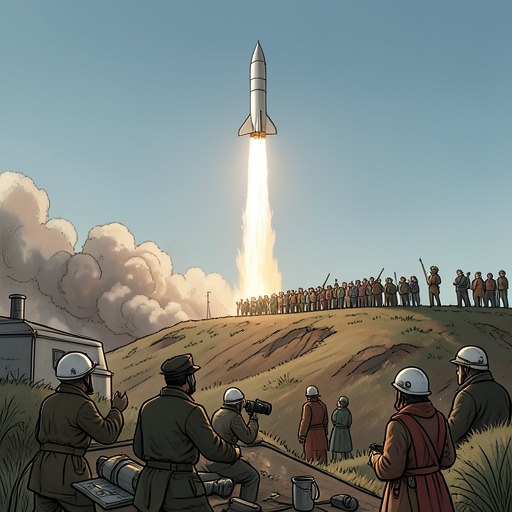
The launch that Kanae and Takaki witness is brief in its ascent but prolonged in its effects on their attention. After the chorus of cicadas falls silent, a roar shakes the air and a ball of fire rises from a distant hill. The nozzle’s light dazzles; flames illuminate the evening clouds; and a tall column of white smoke crosses the setting sun. The rocket disappears into clouds in less than a minute, but the two remain looking upward until the smoke disperses and the sounds of birds, insects, and wind return.
The scene makes spaceflight simultaneously technological and sensory. The rocket’s departure is an engineered event, yet what remains with the witnesses is its brightness, noise, smoke, and temporary alteration of the island’s sky. For Takaki, it becomes his first launch, witnessed at seventeen beside Kanae. A decade later, he still recalls that moment alongside the emotional history of their adolescence: the memory of the launch remains bound to the girl who stood next to him and to the feelings he could not act upon. The agency’s activity thus enters his personal past not as an abstract institutional fact but as a shared event that persists in recollection.
From island infrastructure to adult work
The story also places space and communications technology beside Takaki’s later occupation. As a software engineer, he works in a Mobile Solutions department on software for cell phones and other portable information devices; his main clients are communications service providers and device manufacturers. In a later scene, a television report describes a newly launched satellite as one that will handle communications for mobile devices. Takaki recognizes that the launch is not entirely unrelated to his work, even as he feels how far his life has carried him from Tanegashima.
This connection is deliberately limited: the account does not identify the agency as responsible for that particular satellite or describe its formal organization, mandate, or administrative operations. Instead, it places the launch and mobile communications in the same field of technological dependence. A system that once appeared to Takaki and Kanae as a rocket climbing into the sky also belongs, in another form, to the infrastructure associated with his adult profession. The movement between these scenes gives the National Space Development Agency of Japan a narrative presence that exceeds its signage: spaceflight is at once a spectacle witnessed on an island, a subject preserved in photographs, a logistical operation on the road, and part of a technological world that reaches into ordinary communication.